




The National Electric Vehicle Policy Committee (EV Board) has approved revisions to the EV3 and EV3.5 measures that support local EV production. One key change allows EVs manufactured for export to be counted as 1.5 times towards the production compensation quota. This adjustment is aimed at encouraging manufacturers to establish Thailand as a key export base. The Board also approved an extension of the registration deadline by one month and introduced stricter rules for subsidy disbursement to improve policy effectiveness and manage global market volatility.
Export-Oriented Production Gets 1.5x Credit
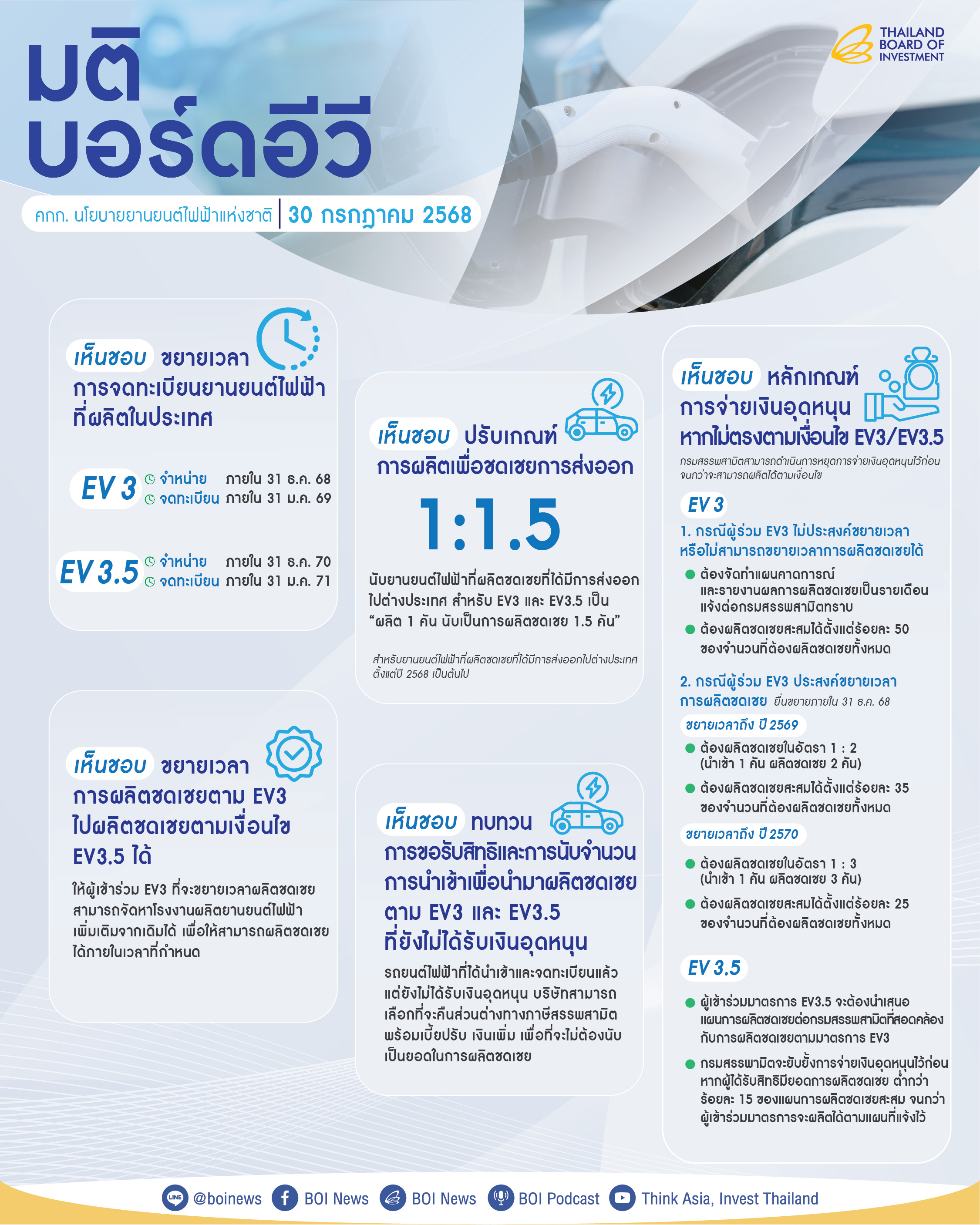
Mr. Narit Therdsteerasukdi, Secretary-General of the Board of Investment (BOI) and Secretary of the EV Board, announced that during the EV Board meeting on July 30, 2025, it was agreed that from 2025 onward, EVs produced in Thailand and exported overseas will be credited as 1.5 units for every 1 unit actually produced under the EV3 and EV3.5 measures.
This move aligns with proposals from the Federation of Thai Industries and the Electric Vehicle Association of Thailand. It is expected to help increase EV exports to approximately 12,500 units in 2025 and 52,000 units in 2026.
Registration Deadline Extended by One Month
To align with the end-of-year vehicle sales and registration cycle, the EV Board approved extending the registration deadlines under existing measures:
-
EV3: Previously required registration by December 31, 2025, now updated to “sold by December 31, 2025, and registered by January 31, 2026.”
-
EV3.5: Changed from registration by December 31, 2027 to “sold by December 31, 2027, and registered by January 31, 2028.”
Stricter Oversight on Subsidy Payments
To ensure responsible disbursement of subsidies under EV3 and EV3.5, the EV Board has established the following additional conditions:
1. Production Plans & Bank Guarantee Requirements
-
EV3 participants not requesting time extensions must prepare a monthly production forecast and report their progress.
-
The Excise Department will withhold subsidy payments until the company has produced at least 50% of its required compensation volume.
-
Participants requesting a time extension must provide a bank guarantee:
-
THB 20 million for companies with registered capital ≥ THB 5 billion
-
THB 40 million for those with registered capital < THB 5 billion
-
2. Additional Production Facilities Allowed
Participants may set up additional EV manufacturing plants to meet their compensation obligations on time.
3. Review of Import Quota Eligibility
If companies have already imported and registered EVs but have not received subsidies, they may choose to return the excise tax difference with penalties and surcharges in order to exclude those units from the compensation quota.
EV Industry Growth in H1 2025: Registrations Up 52%
The EV Board also reviewed the progress of the EV industry. In the first half of 2025, registrations of new battery electric passenger vehicles (BEVs) reached 57,289 units, a 52% increase from the same period last year. These BEVs accounted for over 15% of all new vehicle registrations — the highest proportion in ASEAN.
As of now, Thailand has accumulated more than 203,000 registered BEVs. Other types of EVs include:
-
Electric motorcycles: 71,900 units
-
Electric buses and trucks: 3,800 units
-
Electric tuk-tuks (three-wheelers): 1,000 units
Current Participants in EV3 and EV3.5 Measures
-
EV3: 27 companies
-
16 for cars and pickups
-
11 for motorcycles
-
-
EV3.5: 10 companies (all focused on cars and pickups)
Total vehicles eligible under EV3 and EV3.5: 209,623 units
-
Cars: 175,064 units
-
Motorcycles: 34,559 units
Total Investment in EV Ecosystem Surpasses THB 137 Billion
As of now, Thailand has received over THB 137.7 billion in cumulative investment across the EV value chain, including:
-
BEV production: 21 projects, THB 41.08 billion, total capacity: 386,000 units/year
-
Electric motorcycle production: 16 projects, THB 990 million, capacity: 810,000 units/year
-
Electric bus/truck production: 3 projects, THB 2.2 billion, capacity: 4,800 units/year
-
Battery production: 53 projects, THB 80.06 billion
-
Key EV components (e.g., traction motors, BMS, DCU, onboard chargers): 42 projects, THB 6.52 billion
-
EV charging stations: 29 projects, THB 5.56 billion, with 20,080 chargers (including 7,360 Quick Chargers)
-
Battery swapping stations: 5 projects, THB 1.28 billion
-
For motorcycles: 555 stations
-
For commercial vehicles: 7 stations
-
For passenger cars: 6 stations
-
Public EV Charging Infrastructure Nationwide (as of March 2025)
-
Total charging stations: 3,720
-
Total charging connectors: 11,622
-
DC (fast) chargers: 6,524
-
AC chargers: 5,098
-
-
Charging network now covers all regions of Thailand